
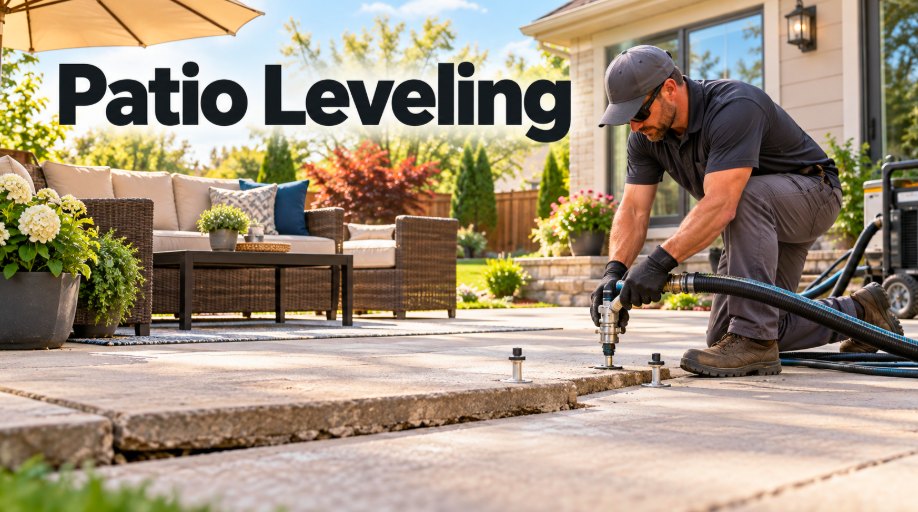
Patio leveling is intended to correct settled concrete slabs while preserving existing patio surfaces whenever their condition allows.
Problems Caused by a Settled Patio
Concrete patio movement can affect more than appearance.
A sunken section may cause:
- Tables or chairs to sit unevenly
- Water to collect near the house
- Slab edges to become noticeable
- Doors and thresholds to have awkward transitions
- Patio covers or posts to appear out of alignment
- Water to remain after rain
- Cracks to widen
- Adjacent walkways to no longer meet properly
Because patios frequently connect directly to the home, elevation and drainage should be evaluated carefully.
Why Patio Concrete Settles
The ground underneath a patio may change years after installation. Soil can compact, shrink, erode, or become saturated depending on drainage and weather conditions.
Settlement may also result from improperly compacted fill, old trenches beneath the patio, water escaping from irrigation lines, roof runoff, or inadequate drainage around the slab.
The visible concrete problem is often only the surface indication of changes occurring underneath it.
Patio Leveling Assessment
Before performing any lifting work, we examine the patio as a complete system.
Important considerations include:
- Direction of existing slope
- Distance from the home
- Door thresholds
- Drain locations
- Patio covers
- Expansion joints
- Adjacent landscaping
- Pool areas
- Walkways
- Outdoor kitchen structures
- Existing cracks
The goal is not simply to make every slab perfectly flat. Exterior concrete often requires purposeful slope so rainfall can move away from buildings and toward appropriate drainage areas.
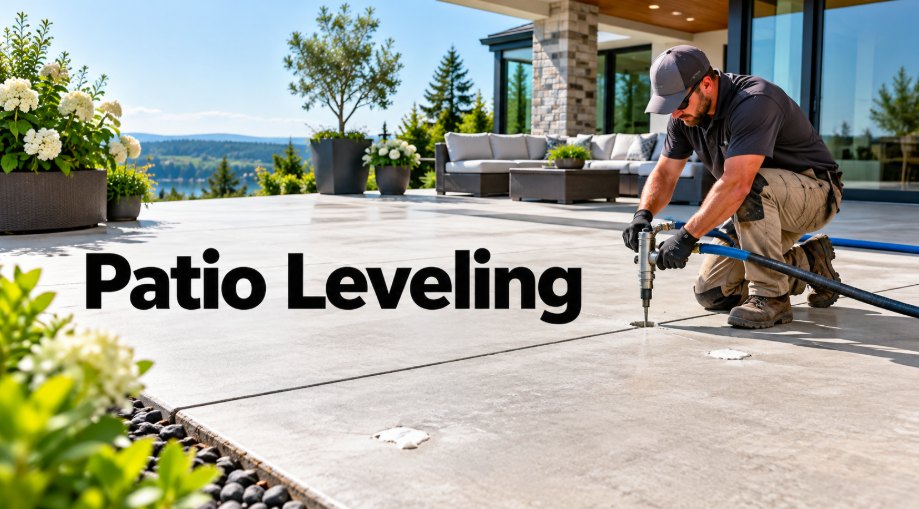
Raising Sunken Patio Slabs
When the patio concrete remains sufficiently intact, selected slabs may be gradually lifted by filling spaces underneath them.
Careful adjustment is particularly important near sliding doors, foundations, walls, pool decking, and attached structures.
The finished elevation is chosen based on surrounding surfaces and drainage requirements rather than an arbitrary height.
Patio Leveling Near the House
Settlement next to an exterior wall should be evaluated promptly, especially when the slab has developed a slope toward the building.
Water repeatedly collecting against the home can create unwanted moisture conditions.
Where appropriate, leveling may restore a more useful slope. However, drainage systems, gutters, downspouts, soil grading, and other conditions may also need attention.
Concrete leveling should be viewed as one part of the overall drainage picture.
Patio Furniture and Outdoor Living Areas
An uneven patio can be particularly frustrating in areas where outdoor furniture is used regularly.
Slight slab movement may result in rocking tables, unstable chairs, uneven barbecue equipment, or uncomfortable transitions between entertainment areas.
Restoring the concrete surface can make an existing patio more functional without immediately rebuilding the outdoor space.
Covered Patio Leveling
Covered patios require additional evaluation because the concrete may surround or support posts and structural elements.
Concrete slabs and structural footings are not always the same component. We identify how the patio was constructed before recommending leveling around columns, posts, or patio-cover supports.
Concrete Patio Repair vs. Replacement
Leveling may be a good choice when the main problem is settlement and the concrete itself remains relatively solid.
Replacement may be preferable when there is extensive deterioration, severe cracking throughout each panel, major structural damage, or an unsuitable existing slab.
Preserving usable concrete can limit demolition, debris, and disruption to nearby landscaping.
Helping Prevent Future Patio Settlement
Good water management is one of the most important ways to protect exterior concrete.
Property owners should watch for:
- Sprinklers spraying directly against slab edges
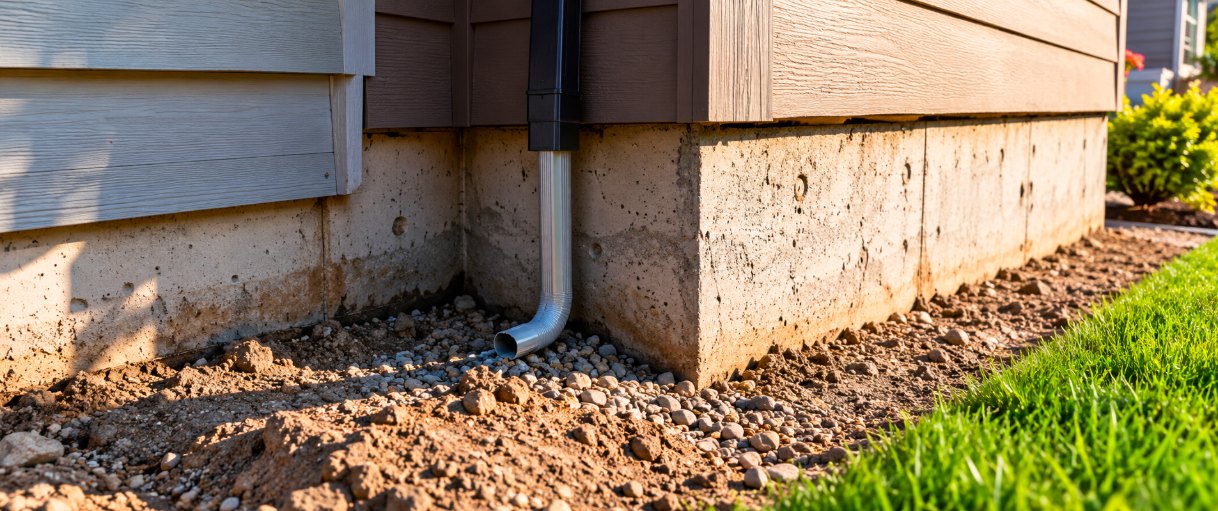
- Downspouts discharging beside the patio
- Standing water
- Leaking outdoor plumbing
- Soil washing away from the slab
- Gaps developing along patio edges
Correcting these conditions may help protect the supporting soil.
Restore Your Existing Patio
A patio does not necessarily need to be demolished simply because sections have settled.
Professional evaluation can determine whether the slabs can be lifted and stabilized while maintaining proper drainage and transitions.
If your patio has sunken panels, uneven surfaces, standing water, or noticeable changes near the house, patio leveling may provide a practical way to restore the space.